H. C. G. Moule affirms the importance of praying for others. “Intercessory prayer is a powerful means of grace to the praying man …. Henry Martyn observed, [intercessory prayers] were for himself, the divinely natural channel of a renewed insight into his own part and lot in Christ, into Christ as his own rest and power, into the perfect freedom of an entire yielding of himself to his master for His work.”
The apostle Paul prayed this inspired prayer the church in Ephesus. We are to embrace this prayer for ourselves and others: “For this reason I bow my knees before the Father, from whom every family in heaven and on earth is named, that according to the riches of his glory he may grant you to be strengthened with power through his Spirit in your inner being, so that Christ may dwell in your hearts through faith—that you, being rooted and grounded in love, may have strength to comprehend with all the saints what is the breadth and length and height and depth, and to know the love of Christ that surpasses knowledge, that you may be filled with all the fullness of God.
Now to him who is able to do far more abundantly than all that we ask or think, according to the power at work within us, to him be glory in the church and in Christ Jesus throughout all generations, forever and ever. Amen.” Ephesianc ch. 3:14-21 ESV
Charles A Cook observes, “Paul’s two intercessory prayers in Ephesians chs 1 and 3 are remarkable in setting forth the believer’s privileges and standing in Christ. As we pray these prayers for others we shall more fully appropriate them for ourselves.”
As believer priests, may we more faithfully intercede in prayer.
“We must not conceive of prayer as overcoming God’s reluctance, but as laying hold of His highest willingness.” ~Richard Trench
Mr. Moody was once addressing a crowded meeting of children in Edinburgh. To get their attention, he began by asking a question that he was prepared to answer himself, “What is prayer?”
Before he could answer the question he was astonished to see almost every little hand shoot straight up into the air. With a smile mixed with uncertainty and anticipation, he pointed to a lad toward the front who answered with a thick accent that identified his Scottish roots, “Prayer is an offering up of our desires unto God for things agreeable to His will, in the name of Christ, with confession of our sins and thankful, acknowledgment of His mercies.”
Nearly a century and a half later, see how much has changed! What sort of answer would he get today? How many Scottish children could give a definition of prayer like the one Moody received? Think for a moment and decide what answer you would give. Oh to see days like this again when youths were not despised for youth’s sake! Today, it is more likely that Moody would not have been taken off guard.
So, let us ask Mr. Moody’s question again: “What is prayer?” In a world where rights are coming out of our ears, we could deduce that most Christians might answer, “Prayer is asking things from God.” Yet when we consider the way our Lord prayed, surely it is something far greater than merely “getting God to run our errands for us.”
To settle with such an answer would be equivalent to saying we are mere beggars at a rich man’s door. And yet God’s Word says that we are His children!
The word “prayer” really means “a wish directed towards,” that is, towards God. This means that when we pray, all our efforts are directed toward someone as opposed to something. Prayer is recognizing the One from whom all blessings flow, knowing that receiving from Him is just the icing on the cake! Consider how David describes this in Psalm 25:1, “Unto Thee, O Lord, do I lift up my soul.” What a beautiful description of prayer that is! When we lift our souls to God, we are committing all that we have, all that we know, and all that concerns us into His hands—and leaving it there. When we lift our souls to God in prayer it allows God to do what He will in us and with us. It is putting ourselves at God’s disposal. God is always on our side. Man’s importunity is God’s opportunity! One poem describes it like this:
Prayer is the soul’s sincere desire, Uttered or unexpressed, The motion of a hidden fire That trembles in the breast.
Prayer is an unspoken bond that links heaven to earth. Sometimes it results in words, and at other times the spirit cries out though lips never part. How then can we describe it as merely asking things from God?
Prayer is also not bending the will of a reluctant God to our will. It does not change His purpose, although it may release His power. We must understand that our prayers are not about persuading a reluctant God, but about trusting in a God who is more willing to give than we are to receive!
God always plans what is best for us. Even when we pray in ignorance or blindness, God will not be swayed from His purpose for our greatest good. However, there are certain instances when, if we persist in asking for something harmful, our stubbornness may bring it about, and we will suffer the consequences. As the Psalmist says, “He gave them their request; but sent leanness into their soul” (Psalm 106:15). In the same way, we too can bring spiritual emptiness upon ourselves, cursed with the burden of a granted prayer.
Prayer, in the minds of some people, is only for emergencies! Danger threatens, sickness comes, things are lacking, difficulties arise—then they pray. Like the unbeliever down a coal mine who teased the Christian miner: when the roof began to fall he began to pray as the old Christian miner quietly remarked, “Aye, there’s nothing like a load o’ coal falling on a man to make him pray.”
In truth, this is why Paul writes to the Thessalonians, “Pray without ceasing” (1 Thessalonians 5:17). When we pray without ceasing, we’re adding wood to keep the fire going—not when it goes out!
Now, asking God for something is a valuable part of prayer if we bear in mind the need to depend on the Giver over the gift. But it is also communion with the Giver—intercourse with God—not just talking to but with God in holy fellowship. It is as simple as getting to know people by simply communicating with them. Prayer should never be monologue as many might think—but dialogue! A man struggling with a besetting sin will never be free of it if deliverance from evil is the result he is anticipating. The same goes for the one who longs to secure some coveted thing. The highest result ought always to be knowing God more intimately. “And this is life eternal, that they might know Thee, the only true God” (John 17:3). Yes, prayer discovers more of God, and that is the soul’s greatest discovery. This is what David meant when he said, “Unto Thee, O Lord, do I lift up my soul” (Psalm 25:1)!
The kneeling Christian discovers why he always finds God on his knees—because God ultimately finds him. The heavenly vision of the Lord Jesus blinded Saul of Tarsus on his journey to Damascus, but Paul later recounts that while praying in the temple at Jerusalem, he fell into a trance and beheld Jesus, stating, “I . . . saw him” (Acts 22:18), and it was then that Christ assigned him to the Gentiles. When we pray, we should also be ready to go down the path that God will prepare for us.
Horace Bushnell was known for his influential writings on prayer. A friend of Bushnell once recounted a profound sense of God’s presence while praying with Bushnell: “When Horace Bushnell buried his face in his hands and prayed, I was afraid to stretch out my hand in the darkness, lest I should touch God.” Perhaps this is the very heart of David’s plea, “My soul, wait thou only upon God” (Psalm 62:5).
“What is prayer?” By now you might be ready to answer Mr. Moody’s question a little better. Now let us advance further into the veil of fellowship. It is one thing to recognize that we are always in God’s presence, and for that presence to be manifested, but it is quite another to gaze upon Him in adoration. But perhaps we should ask God Himself what He considers to be the highest form of prayer. I think higher than an awareness of His presence, or even adoration of His presence, there is communion with Him as a friend with a friend. This is the essence of true prayer.
What made Count Zinzendorf of Herrnhut such a man of prayer? He sought the Giver rather than His gifts. He said, “I have one passion: it is Christ, and Christ alone.”
Even followers of Islam recognize this concept. They describe three levels of prayer: the first is merely verbal, spoken by the lips; the second involves a determined effort to focus our thoughts on the Divine; and the third is when the soul struggles to turn away from God. Certainly, we understand that God invites us to ‘ask’ of Him, and we typically respond to this call. We can be confident that prayer not only pleases God but also meets all our needs. However, it would be unusual for a child to seek their father’s presence solely for a gift. Every child needs their father! And this is why Proverbs 17:6 declares that “the glory of children are their fathers.” This is the very attitude we ought to have as children of God. No child is content with piles of stuff. Every child who enjoys time with their father is content. So how is this achieved?
Here are two thoughts to consider: 1) There must be a realization of God’s glory. 2) There must be a realization of God’s grace.
I’ve found the way, through the blood, past the veil, to the Holy of Holies with God. There by His pow’r over sin, I prevail, I can walk in the path that He trod. There in the presence of Jesus, I stand; Glorified Son at the Father’s right hand. There, I can plead, I can claim, I can have all that He purchased for me!
I wonder how many of us take the time to marvel over God’s exceeding great glory. How many of us take the time to grasp a fuller meaning of the little word grace? Are our prayers often ineffective and weak because we hastily enter God’s presence without truly considering His majesty and glory, or taking the time to reflect on the greatness of the God we are approaching? The time element is often a reason so few see the effectiveness of prayer today. May we then suggest that before we lay our petitions before God we first dwell in meditation upon His glory and grace. Like David, may we lift our soul “unto Thee, O LORD.” Let us place ourselves, as it were, in the presence of God and direct our prayer to the King of kings, and Lord of lords, “Who only hath immortality, dwelling in the light which no man can approach unto . . . to Whom be honour and power everlasting” (I Tim. 6:16). And then, let us adore Him and praise Him for His exceeding great glory. Yet more than this, let us like Moses, speak to Him as friend with friend.
O come let us adore Him, O come let us adore Him, O come let us adore Him, Christ the Lord!
“Our Father, which art in heaven, hallowed be Thy name . . .” (Matthew 6:9b). There is nothing like a glimpse of heaven and a knowledge of God’s glorious name to banish fear and doubt! A.T. Pierson often would describe George Müller as having such a walk with God that his very presence carried with it a sense of the divine. He was a man of God, full of faith and the Holy Ghost, and in his daily life, there was a princely air of confidence that came from trusting God fully. How is this? Because he got a glimpse of the glory of God, and in adoration praised him before opening his mouth wide, and his princely air was not one of pride, but of awareness that he was a son of God (1 John 3:1)! “Our Father . . . in heaven . . . hallowed be Thy name. . . ”
Realizing the glory of God—Who is a spirit (John 4:24) and Whom none have ever seen (John 1:18)—is necessary to adequately praise and adore Him. How can this be done, practically speaking? It was William Law who said, “When you begin to pray, use such expressions of the attributes of God as will make you sensible of His greatness and power.”
How many names and descriptions of our God do you know? Psalms 100:4 says, “Enter into His gates with thanksgiving, and into His courts with praise.” Perhaps your thankfulness for things are getting in the way of achieving a powerful sense of the reality of God’s glory. So the psalmist is more specific as he continues, “. . . be thankful unto Him, and bless His name.” As you enter into His gates, remind yourself that you are entering into the presence of The Provider—Jehovah Jireh, The Healer—Jehovah Rapha, The One Who is our Banner of Victory—Jehovah Nissi. When you enter into His courts, you might well whisper, “El Shaddai, You are my sufficiency—the Almighty One—in every circumstance,” or “Jehovah Shalom, Your peace calms my every storm,” or “Jehovah Rohi, I shall never want for You as my Shepherd.” Say these things aloud! “You are Almighty, Unchangeable, Loving, Caring, Compassionate, and the One Who hears us when we call.” Discover His character! This is why Paul counted everything else to be dung in comparison to knowing God. Paul had such an awareness of God and His constant presence that He could do nothing but adore Him.
Yes, in Thy Name, O Captain of Salvation, In Thy dear Name, all other names above, Jesus, our Righteousness, our Sure Foundation, Our Prince of Glory, and our King of Love!
This chapter is taken from “The Kneeling Christian”. For more information on this book CLICK HERE.
Believers have the privilege and opportunity to personally confide in God about the delights and heartaches of life through prayer.
We have an example of this in Jeremiah 20:9,10,11,13:
“Then I said, ‘I will not make mention of Him, Nor speak anymore in His name.’ But His word was in my heart like a burning fire Shut up in my bones; I was weary of holding it back, And I could not … All my acquaintances watched for my stumbling, saying, ‘Perhaps he can be induced; Then we will prevail against him, And we will take our revenge on him.’ But the Lord is with me as a mighty, awesome One. Therefore my persecutors will stumble, and will not prevail… Sing to the Lord! Praise the Lord! For He has delivered the life of the poor From the hand of evildoers.”
About this prophet’s experience, F. B. Meyer observed:
“God always seemed nigh at hand. His ear always bent down to the least whisper of His servant’s need. Compelled to live much alone, this much-suffering man (Jeremiah) acquired the habit of counting on the companionship of God as one of the undoubted facts of his life. He poured into the ear of God every thought as it passed through his soul. He spread forth his roots by the river of God, which is full of water. There was no fear therefore that his leaf would become withered in the summer heat, or that he would cease from yielding fruit in the year of drought [Jer. 17:8].
“Let us seek this attitude of soul, which easily turns from man to God; not forgetting the hours of prolonged fellowship [with God in personal prayer], but, in addition, acquiring the habit of talking over our life with one who does not need to be informed of what transpires, but awaits with infinite desire to receive the confidence of His children. Talk over each detail of your life with God, telling Him all things, and finding the myriad needs of the soul satisfied in Him.”
The College of Prayer is a ministry based in Georgia that has as its purpose: “Mentoring pastors and leaders to reach a lost world through a revived church.”
Their resources are valuable to encourage and equip all who desire a more dynamic prayer life.
They have a Ignite Conference scheduled for September 12-14, 2024. Here is a promotional video:
Pastor Fred Hartley also produces The Kingdom Leadership Podcast.
Their Revival Now Media app features video resources, audio resources, and printed materials, “leading people to a fresh encounter with Christ and equipping them to live lives empowered by the Holy Spirit.”
                         from THE KNEELING CHRISTIAN

                        By "AN UNKNOWN CHRISTIAN"
“Whatsoever ye shall ask in my name, that will I do, that the Father may be glorified in the Son. If ye shall ask anything in my name, I will do it” (John xiv. 13, 14).
This was something quite new, for our Lord said so. “Hitherto ye have asked nothing in my name,” but now, “ask and ye shall receive, that your joy may be full” (John xvi. 24).
Five times over our Lord repeats this simple condition, “In my name” (John xiv. 13, 14; xv. 16; xvi. 23, 24, 26). Evidently something very important is here implied. It is more than a condition–it is also a promise, an encouragement, for our Lord’s biddings are always His enablings. What, then, does it mean to ask in His name? We must know this at all costs, for it is the secret of all power in prayer…
(1) There is a sense in which some things are done only “for Christ’s sake”–because of His atoning death. Those who do not believe in the atoning death of Christ cannot pray “in His name.” They may use the words, but without effect. For we are “justified by His blood” (Rom. v. 9), and “we have redemption through His blood, even the forgiveness of sins” (Eph. i. 7; Col. i. 14)….
(2) The most familiar illustration of coming “in the name” of Christ is that of drawing money from a bank by means of a check. I can draw from my bank account only up to the amount of my deposit there. In my own name, I can go no farther. In the Bank of England I have no money whatsoever, and can therefore draw nothing therefrom. But suppose a very wealthy man who has a big account there gives me a blank check bearing his signature, and bids me fill it in to any amount I choose. He is my friend. What shall I do? Shall I just satisfy my present need, or shall I draw as much as I dare? I shall certainly do nothing to offend my friend, or to lower myself in his esteem. Well, we are told by some that heaven is our bank. God is the Great Banker, for “every good gift and every perfect gift is from above, and cometh down from the Father” (James i. 17)….
But He bids us to remember that we should ask only for those things that are according to His will–only for that which will bring glory to His name. John says, “If we ask anything according to His will, He heareth us” (I John v. 14). So then our Friend gives us a blank check, and leaves us to fill in “anything”; but He knows that if we truly love Him we shall never put down–never ask for–things He is not willing to give us, because they would be harmful to us…
(3) But even now we have not exhausted the meaning of those words, “In my Name.” We all know what it is to ask for a thing “in the name” of another. But we are very careful not to allow anyone to use our name who is not to be trusted, or he might abuse our trust and discredit our name….The great Heavenly Banker will not cash checks for us if our motives are not right. Is not this why so many fail in prayer? Christ’s name is the revelation of His character.
To pray “in His name” is to pray in His character, as His representative sent by Him: it is to pray by His Spirit and according to His will; to have His approval in our asking, to seek what He seeks, to ask help to do what He Himself would wish to be done, and to desire to do it not for our own glorification, but for His glory alone. To pray “in His name” we must have identity of interests and purpose. Self and its aims and desires must be entirely controlled by God’s Holy Spirit, so that our wills are in complete harmony with Christ’s will.
We must reach the attitude of St. Augustine when he cried, “O Lord, grant that I may do Thy will as if it were my will, so that Thou mayest do my will as if it were Thy will.”…
Child of God, does this seem to make prayer “in His name” quite beyond us? That was not our Lord’s intention. He is not mocking us! Speaking of the Holy Spirit our Lord used these words: “The Comforter . . . Whom the Father will send in my name” (John xiv. 26). Now, our Savior wants us to be so controlled by the Holy Spirit that we may act in Christ’s name. “As many as are led by the Spirit of God, they are the sons of God” (Rom. viii. 14). And only sons can say, “Our Father.”
_____
From The Kneeling Christian, Chapter 6 “How Shall I Pray?” This is available for free download here.
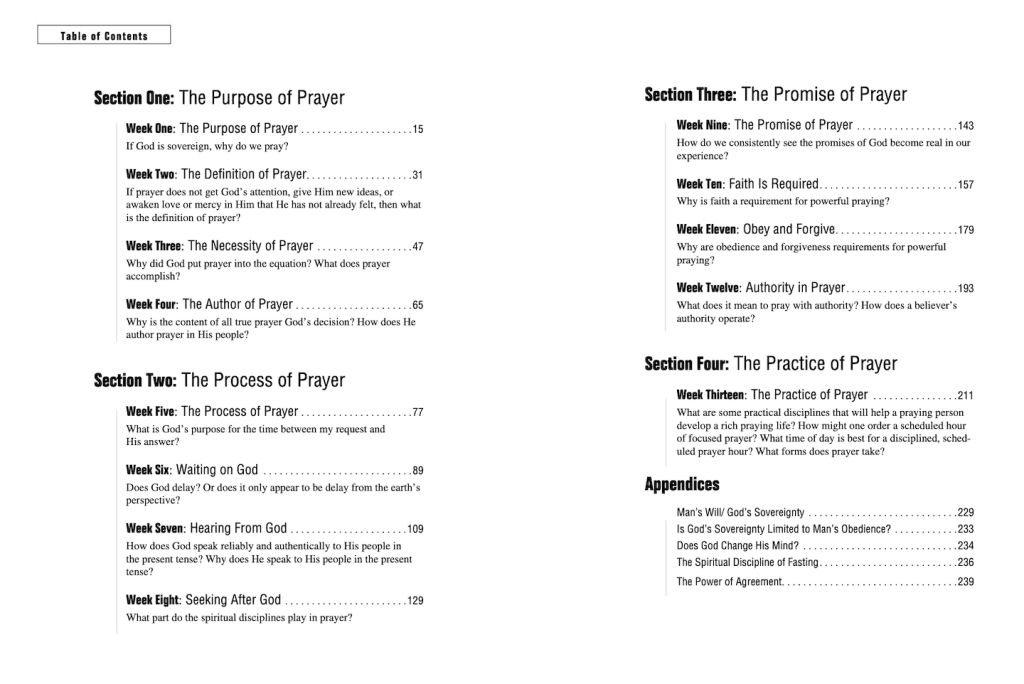
I had the opportunity of correspondence and a phone conversation with Jennifer Kennedy Dean before she went to be with the Lord. Her books and videos on living a praying life have a helpful biblical scope and grace orientation. Here is some publisher’s information about her best known workbook:
Live a Praying Life(R)! gives readers keys to authentic Christian living through a deepened prayer life. For more than 20 years, Jennifer Kennedy Dean has researched and practiced the principles of her bestselling Bible study of the same title. This new trade edition breaks down and delivers the time‐tested principles of praying. Readers will find it easy to understand prayer–its purpose, process, practice, and promise as they look at prayer through God’s view–His Word. Excellent illustrations and word pictures describe how to get at prayer that pleases God and satisfies the pray‐er’s deepest desires.
Jennifer Kennedy Dean was the executive director of the Praying Life Foundation and a respected author and speaker. Her numerous books, studies, and magazine articles specialized in prayer and spiritual formation, and her work Live a Praying Life(R) has been called a flagship work on prayer. With more than 25 published titles, some of her works include Heart’s Cry, Prized, SEEK, Clothed with Power, Set Apart, Power in the Blood of Christ, Power in the Name of Jesus, Altar’d, and Conversations with the Most High, among others. Widely recognized as an unusually gifted communicator, Jennifer spoke all over the world, calling God’s people to discover the difference between a prayer life and a praying life. She served on numerous boards and committees for ministries focused on prayer and spiritual awakening. She will always be remembered as a respected voice in the area of prayer.
“…praying always with all prayer and supplication in the Spirit, being watchful to this end with all perseverance and supplication for all the saints…” Ephesians 6:18
We should try to believe as we pray, think as we pray, feel as we pray and act as we pray. Prayer must not be a solitary, independent exercise but inseparably connected with our lives and what we do. Prayer is an incentive to useful living but not a substitute for it.
The person whose heart has been set in motion by prayer, and whose spiritual pulse quickened by Scripture, has work to do.
He has a responsibility to feed the poor, comfort the sad, help the distressed, teach the ignorant and soothe the depressed. At home, he has his family to teach, watch over and be an example to.
But his most difficult work will be on himself. He has to watch against all sorts of sins, errors and temptations which he will find heavier in weight and more in number the more closely he looks at them: against prejudice; against impatience when his wisely thought out plans are defeated; against cold and heartless prayer; against over-anxiety about things. He has to watch because he finds that he does not show, as clearly as he might, in his life, the attitude that he has when on his knees before God; that his best obedience is incomplete; that his faith, though sincere, often lacks energy; that it is difficult to ‘take captive every thought to make it obedient to Christ’ (2 Corinthians 10:5).
He may have to watch against the fear of man, as he may he may find it easier to endure the cross than to despise the shame; or against an eager desire for popularity; to watch in order to keep himself unspotted from the world—to hold the things of the world with a loose hand—and to achieve consistency of character.
He will want to walk with God—not merely bow down before him at stated intervals, or address him ceremoniously on great occasions and then retreat and live at a distance, but walk with him communicate intimately, naturally and continually with him.
“Continue earnestly in prayer, being vigilant in it with thanksgiving; meanwhile praying also for us… Epaphras, who is one of you, a bondservant of Christ, greets you, always laboring fervently for you in prayers, that you may stand perfect and complete in all the will of God” (Col. 4:2,3,12).
O. Hallesby observed two hindrances to prayer with a reminder of the enablement to pray effectively.
“There are things in us which are a hindrance to our prayers. These hindrances are what the Spirit of prayer points out to us.
“First and foremost there is our selfishness. We live and move and such a narrow circle that the Spirit of prayer cannot create in our hearts true zeal for others. However, the Spirit can convict us of this sin. And as soon as I acknowledge my selfish and indifference, He will save me from it.”
“Secondly, there is our love of ease. That is why Jesus admonishes us to watch and pray. The apostle Paul speaks of it as striving in prayer. To strive in prayer means to be so watchful at all times that we can notice when we become slothful in prayer and go to the Spirit of prayer to have this remedied.[1]
“Likewise the Spirit also helps in our weaknesses. For we do not know what we should pray for as we ought, but the Spirit Himself makes intercession for us with groanings which cannot be uttered. Now He who searches the hearts knows what the mind of the Spirit is, because He makes intercession for the saints according to the will of God” (Rom. 8:26,27).
Andrew Murray, pastor and author from South Africa, continues to inspire believers through the legacy of his books. These include With Christ in The School of Prayer. In his book, The Prayer Life, he offers this insight to help the believer overcome discouragement regarding his/her prayer life.
“Many a one has turned to his inner chamber, under bitter self accusation that he has prayed so little, and has resolved for the future to live in a different manner. Yet no blessing has come — there was not the strength to continue faithful, and the call to repentance had no power, because his eyes had not been fixed on the Lord Jesus, If he had only understood, he would have said: ‘Lord, thou seest how cold and dark my heart is; I know that I must pray, but I feel I cannot do so. I lack the urgency and desire to pray.’
“He did not know that at that moment the Lord Jesus in his tender love was looking down upon him and saying: ‘You cannot pray; you feel that all is cold and dark: why not give yourself over into my hands? Only believe that I am ready to help you in prayer; I long greatly to shed abroad my love in your heart, so that you, in the consciousness of weakness, may confidently rely on me to bestow the grace of prayer. Just as I will cleanse you from all other sins, so also will I deliver from the sin of prayerlessness — only do not seek the victory in your own strength. Bow before me as one who expects everything from his Saviour. Let your soul keep silence before me however sad you feel your state to be. Be assured of this – I will teach you how to pray.'” *
May we be encouraged my the grace of the Lord Jesus and the intercessory ministry of the Holy Spirit (Rom. 8:16,26,27).
*From chapter 3. Read the full book in PDF here: The Prayer Life.
God’s Word has many examples of prayer as speaking to God as well as listening for His response. To the prophets God’s response was sometimes in an audible voice. We have this prophetic Word confirmed, so the Bible should always be believed as God’s authoritative, inspired, written revelation (2 Peter 1:16-21).
“Now the Lord came and stood and called as at other times, ‘Samuel! Samuel!’ And Samuel answered, ‘Speak, for Your servant hears.’ (1 Sam. 3:10).
Yet sometimes God replies in other ways…such as a whisper: “Then He said, ‘Go out, and stand on the mountain before the LORD.’ And behold, the Lord passed by, and a great and strong wind tore into the mountains and broke the rocks in pieces before the Lord, but the Lord was not in the wind; and after the wind an earthquake, but the Lord was not in the earthquake; and after the earthquake a fire, but the Lord was not in the fire; and after the fire a still small voice….” (1 Kings 19:11,12).
The whisper to Elijah was still external, but often the a “still small voice” is sensed in one’s heart. Kenneth N Taylor observed that “Prayer should be a two-way communication. Since there is no voice of God speaking in the room, you need to learn how He speaks in the silence of your heart and mind. I believe this takes practice and experience. Ask God to help you to know His will. If a thought keeps returning to you, talk it over with others. Don’t act hastily. Not every thought that pops into your head while you’re praying is from God.” When an impression comes to the mind in listening prayer, discernment is needed.
Dallas Willard defended listening prayer is a valid aspect of the Christian’s spiritual life: “Hearing God? A daring idea, some would say–presumptuous and even dangerous. But what if we are made for it? What if the human system simply will not function properly without it? There are good reasons to think it will not. The fine texture as well as the grand movements of life show our need to hear God. Isn’t it more presumptuous and dangerous, in fact, to undertake human existence without hearing God?”
So let’s consider prayer as speaking with God but also listening, and looking for various ways He conveys His answers. W.E. Sangster noted, “Prayer, in its essence, is fellowship with God; it is talking and listening to, and loving the Supreme Being who made, and maintains this universe.”
Books that explore listening prayer include:
Dialogue with God, by Mark Virkler
The Art of Listening Prayer, by Seth Barnes
Hearing God: Developing a Conversational Relationship with God, by Dallas Willard.
Be Still and Know that I Am God, by A & J. Reinhold
Hearing God’s Voice, by Vern Heidebrecht
Listening Prayer: Learning to Hear God’s Voice and Keep a Prayer Journal, by Leanne Payne
Listening Prayer in the context of therapeutic personal ministry:
Transformation Prayer Ministry: Principles, Purpose, Process, by Ed an Joshua Smith
The Immanuel Approach: For Emotional Healing and For Life, by Karl Lehman
In John 10:27 Lord Jesus speaks to us as the Good Shepherd: “My sheep hear My voice, and I know them, and they follow Me.”