The College of Prayer – Resources

The College of Prayer is a ministry based in Georgia that has as its purpose: “Mentoring pastors and leaders to reach a lost world through a revived church.”

Their resources are valuable to encourage and equip all who desire a more dynamic prayer life.

They have a Ignite Conference scheduled for September 12-14, 2024. Here is a promotional video:

collegeofprayer.subspla.sh/9my73q7

Pastor Fred Hartley also produces The Kingdom Leadership Podcast.

Their Revival Now Media app features video resources, audio resources, and printed materials, “leading people to a fresh encounter with Christ and equipping them to live lives empowered by the Holy Spirit.”

For more information, visit www.collegeofprayer.org/

Posted in General | Leave a comment

Praying in Jesus Name

                         from THE KNEELING CHRISTIAN

                        By "AN UNKNOWN CHRISTIAN"

“Whatsoever ye shall ask in my name, that will I do, that the Father may be glorified in the Son. If
ye shall ask anything in my name, I will do it” (John xiv. 13, 14).

This was something quite new, for our Lord said so. “Hitherto ye have asked nothing in my name,” but now, “ask and ye shall receive, that your joy may be full” (John xvi. 24).

Five times over our Lord repeats this simple condition, “In my name” (John xiv. 13, 14; xv. 16; xvi. 23, 24, 26). Evidently something very important is here implied. It is more than a condition–it is also a
promise, an encouragement, for our Lord’s biddings are always His enablings. What, then, does it mean to ask in His name? We must know this at all costs, for it is the secret of all power in prayer…

(1) There is a sense in which some things are done only “for Christ’s sake”–because of His atoning death. Those who do not believe in the atoning death of Christ cannot pray “in His name.” They may use the words, but without effect. For we are “justified by His blood” (Rom. v. 9), and “we have redemption through His blood, even the forgiveness of sins” (Eph. i. 7; Col. i. 14)….

(2) The most familiar illustration of coming “in the name” of Christ is that of drawing money from a bank by means of a check. I can draw from my bank account only up to the amount of my deposit there. In my own name, I can go no farther. In the Bank of England I have no money whatsoever, and can therefore draw nothing therefrom. But suppose a very wealthy man who has a big account there gives me a blank check bearing his signature, and bids me fill it in to any amount I choose. He is my friend. What shall I do? Shall I just satisfy my present need, or shall I draw as much as I dare? I shall certainly do nothing to offend my friend, or to lower myself in his esteem. Well, we are told by some that heaven is our bank. God is the Great Banker, for “every good gift and every perfect gift is from above, and
cometh down from the Father” (James i. 17)….

But He bids us to remember that we should ask only for those things that are according to His will–only for that which will bring glory to His name. John says, “If we ask anything according to His will, He heareth us” (I John v. 14). So then our Friend gives us a blank check, and leaves us to fill in “anything”; but He knows that if we truly love Him we shall never put down–never ask for–things He is not willing to give us, because they would be harmful to us…

    (3) But even now we have not exhausted the meaning of those words, “In my Name.” We all know what it is to ask for a thing “in the name” of another. But we are very careful not to allow anyone to use our name who is not to be trusted, or he might abuse our trust and discredit our name….The great Heavenly Banker will not cash checks for us if our motives are not right. Is not this why so many fail in prayer? Christ’s name is the revelation of His character.

    To pray “in His name” is to pray in His character, as His representative sent by Him: it is to pray by His Spirit and according to His will; to have His approval in our asking, to seek what He seeks, to ask help to do what He Himself would wish to be done, and to desire to do it not for our own glorification, but for His glory alone. To pray “in His name” we must have identity of interests and purpose. Self and its aims and desires must be entirely controlled by God’s Holy Spirit, so that our wills are in complete harmony with Christ’s will.

    We must reach the attitude of St. Augustine when he cried, “O Lord, grant that I may do Thy will as if it were my will, so that Thou mayest do my will as if it were Thy will.”…

    Child of God, does this seem to make prayer “in His name” quite beyond us? That was not our Lord’s intention. He is not mocking us! Speaking of the Holy Spirit our Lord used these words: “The Comforter . . . Whom the Father will send in my name” (John xiv. 26). Now, our Savior wants us to be so controlled by the Holy Spirit that we may act in Christ’s name. “As many as are led by the Spirit of God, they are the sons of God” (Rom. viii. 14). And only sons can say, “Our Father.”

    _____

    From The Kneeling Christian, Chapter 6 “How Shall I Pray?” This is available for free download here.


    Posted in General | Leave a comment

    Live a Praying Life

    I had the opportunity of correspondence and a phone conversation with Jennifer Kennedy Dean before she went to be with the Lord. Her books and videos on living a praying life have a helpful biblical scope and grace orientation. Here is some publisher’s information about her best known workbook:

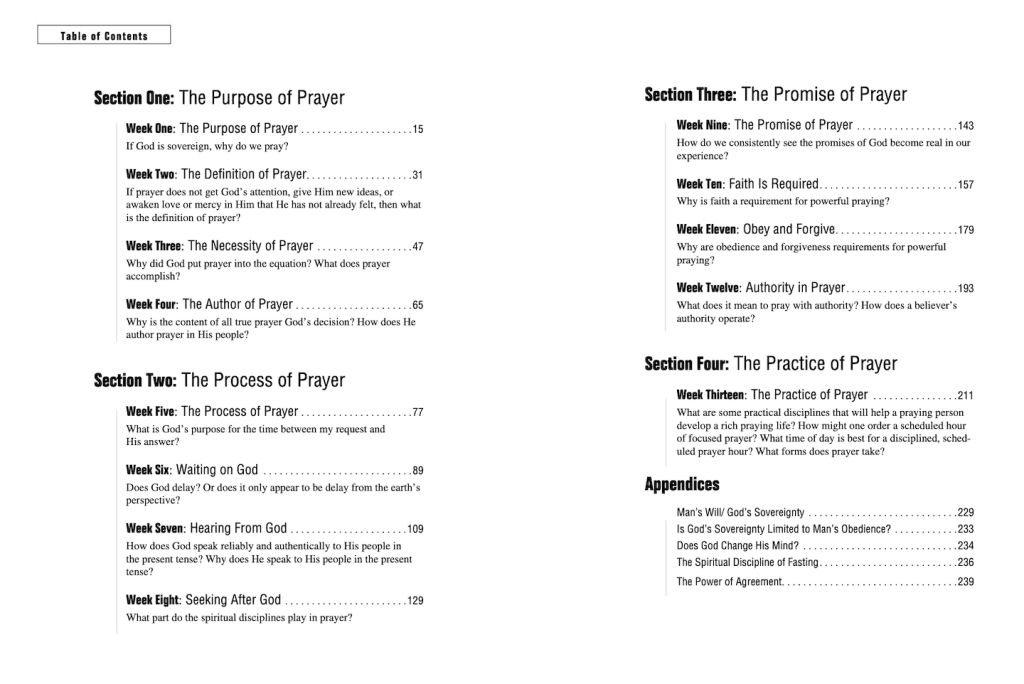
    Live a Praying Life(R)! gives readers keys to authentic Christian living through a deepened prayer life. For more than 20 years, Jennifer Kennedy Dean has researched and practiced the principles of her bestselling Bible study of the same title. This new trade edition breaks down and delivers the time‐tested principles of praying. Readers will find it easy to understand prayer–its purpose, process, practice, and promise as they look at prayer through God’s view–His Word. Excellent illustrations and word pictures describe how to get at prayer that pleases God and satisfies the pray‐er’s deepest desires.

    Jennifer Kennedy Dean was the executive director of the Praying Life Foundation and a respected author and speaker. Her numerous books, studies, and magazine articles specialized in prayer and spiritual formation, and her work Live a Praying Life(R) has been called a flagship work on prayer. With more than 25 published titles, some of her works include Heart’s Cry, Prized, SEEK, Clothed with Power, Set Apart, Power in the Blood of Christ, Power in the Name of Jesus, Altar’d, and Conversations with the Most High, among others. Widely recognized as an unusually gifted communicator, Jennifer spoke all over the world, calling God’s people to discover the difference between a prayer life and a praying life. She served on numerous boards and committees for ministries focused on prayer and spiritual awakening. She will always be remembered as a respected voice in the area of prayer.

    You can sample the first three days of Live a Praying Life (New Hope Publishers, 2011) at this site:
    https://issuu.com/jenniferkennedydean/docs/liveprayinglife

    Posted in General | Tagged | Leave a comment

    A Praying Life

    “…praying always with all prayer and supplication in the Spirit, being watchful to this end with all perseverance and supplication for all the saints…” Ephesians 6:18

    We should try to believe as we pray, think as we pray, feel as we pray and act as we pray. Prayer must not be a solitary, independent exercise but inseparably connected with our lives and what we do. Prayer is an incentive to useful living but not a substitute for it.

    The person whose heart has been set in motion by prayer, and whose spiritual pulse quickened by Scripture, has work to do.

    He has a responsibility to feed the poor, comfort the sad, help the distressed, teach the ignorant and soothe the depressed. At home, he has his family to teach, watch over and be an example to.

    But his most difficult work will be on himself. He has to watch against all sorts of sins, errors and temptations which he will find heavier in weight and more in number the more closely he looks at them: against prejudice; against impatience when his wisely thought out plans are defeated; against cold and heartless prayer; against over-anxiety about things. He has to watch because he finds that he does not show, as clearly as he might, in his life, the attitude that he has when on his knees before God; that his best obedience is incomplete; that his faith, though sincere, often lacks energy; that it is difficult to ‘take captive every thought to make it obedient to Christ’ (2 Corinthians 10:5).

    He may have to watch against the fear of man, as he may he may find it easier to endure the cross than to despise the shame; or against an eager desire for popularity; to watch in order to keep himself unspotted from the world—to hold the things of the world with a loose hand—and to achieve consistency of character.

    He will want to walk with God—not merely bow down before him at stated intervals, or address him ceremoniously on great occasions and then retreat and live at a distance, but walk with him communicate intimately, naturally and continually with him.

    H. More, T. Cadell

    Posted in General | Tagged , | Leave a comment

    Overcoming Hindrances

    “Continue earnestly in prayer, being vigilant in it with thanksgiving;  meanwhile praying also for us…
    Epaphras, who is one of you, a bondservant of Christ, greets you, always laboring fervently for you in prayers, that you may stand perfect and complete in all the will of God” (Col. 4:2,3,12).

    O. Hallesby observed two hindrances to prayer with a reminder of the enablement to pray effectively.

    “There are things in us which are a hindrance to our prayers. These hindrances are what the Spirit of prayer points out to us.

    “First and foremost there is our selfishness. We live and move and such a narrow circle that the Spirit of prayer cannot create in our hearts true zeal for others. However, the Spirit can convict us of this sin. And as soon as I acknowledge my selfish and indifference, He will save me from it.”

    “Secondly, there is our love of ease. That is why Jesus admonishes us to watch and pray. The apostle Paul speaks of it as striving in prayer. To strive in prayer means to be so watchful at all times that we can notice when we become slothful in prayer and go to the Spirit of prayer to have this remedied.[1]

    “Likewise the Spirit also helps in our weaknesses. For we do not know what we should pray for as we ought, but the Spirit Himself makes intercession for us with groanings which cannot be uttered. Now He who searches the hearts knows what the mind of the Spirit is, because He makes intercession for the saints according to the will of God” (Rom. 8:26,27).

    ________

    [1] O. Hallesby, Prayer (IVF, 1948) 85.


    Posted in General | Leave a comment

    Grace to Overcome Prayerlessness

    Andrew Murray, pastor and author from South Africa, continues to inspire believers through the legacy of his books. These include With Christ in The School of Prayer. In his book, The Prayer Life, he offers this insight to help the believer overcome discouragement regarding his/her prayer life.

    “Many a one has turned to his inner chamber, under bitter self accusation that he has prayed so little, and has resolved for the future to live in a different manner. Yet no blessing has come — there was not the strength to continue faithful, and the call to repentance had no power, because his eyes had not been fixed on the Lord Jesus, If he had only understood, he would have said: ‘Lord, thou seest how cold and dark my heart is; I know that I must pray, but I feel I cannot do so. I lack the urgency and desire to pray.’

    “He did not know that at that moment the Lord Jesus in his tender love was looking down upon him and saying: ‘You cannot pray; you feel that all is cold and dark: why not give yourself over into my hands? Only believe that I am ready to help you in prayer; I long greatly to shed abroad my love in your heart, so that you, in the consciousness of weakness, may confidently rely on me to bestow the grace of prayer. Just as I will cleanse you from all other sins, so also will I deliver from the sin of prayerlessness — only do not seek the victory in your own strength. Bow before me as one who expects everything from his Saviour. Let your soul keep silence before me however sad you feel your state to be. Be assured of this – I will teach you how to pray.'” *

    May we be encouraged my the grace of the Lord Jesus and the intercessory ministry of the Holy Spirit (Rom. 8:16,26,27).

    *From chapter 3. Read the full book in PDF here: The Prayer Life.

    Posted in General | Tagged , | Leave a comment

    Listening Prayer


    God’s Word has many examples of prayer as speaking to God as well as listening for His response. To the prophets God’s response was sometimes in an audible voice. We have this prophetic Word confirmed, so the Bible should always be believed as God’s authoritative, inspired, written revelation (2 Peter 1:16-21).

    “Now the Lord came and stood and called as at other times, ‘Samuel! Samuel!’
    And Samuel answered, ‘Speak, for Your servant hears.’ (1 Sam. 3:10).

    Yet sometimes God replies in other ways…such as a whisper: “Then He said, ‘Go out, and stand on the mountain before the LORD.’ And behold, the Lord passed by, and a great and strong wind tore into the mountains and broke the rocks in pieces before the Lord, but the Lord was not in the wind; and after the wind an earthquake, but the Lord was not in the earthquake; and after the earthquake a fire, but the Lord was not in the fire; and after the fire a still small voice….” (1 Kings 19:11,12).

    The whisper to Elijah was still external, but often the a “still small voice” is sensed in one’s heart. Kenneth N Taylor observed that “Prayer should be a two-way communication. Since there is no voice of God speaking in the room, you need to learn how He speaks in the silence of your heart and mind. I believe this takes practice and experience. Ask God to help you to know His will. If a thought keeps returning to you, talk it over with others. Don’t act hastily. Not every thought that pops into your head while you’re praying is from God.” When an impression comes to the mind in listening prayer, discernment is needed.

     Dallas Willard defended listening prayer is a valid aspect of the Christian’s spiritual life: “Hearing God? A daring idea, some would say–presumptuous and even dangerous. But what if we are made for it? What if the human system simply will not function properly without it? There are good reasons to think it will not. The fine texture as well as the grand movements of life show our need to hear God. Isn’t it more presumptuous and dangerous, in fact, to undertake human existence without hearing God?”

    So let’s consider prayer as speaking with God but also listening, and looking for various ways He conveys His answers. W.E. Sangster noted, “Prayer, in its essence, is fellowship with God; it is talking and listening to, and loving the Supreme Being who made, and maintains this universe.”

    Books that explore listening prayer include:

    • Dialogue with God, by Mark Virkler
    • The Art of Listening Prayer, by Seth Barnes
    • Hearing God: Developing a Conversational Relationship with God, by Dallas Willard.
    • Be Still and Know that I Am God, by A & J. Reinhold
    • Hearing God’s Voice, by Vern Heidebrecht
    • Listening Prayer: Learning to Hear God’s Voice and Keep a Prayer Journal, by Leanne Payne

    Listening Prayer in the context of therapeutic personal ministry:

    • Transformation Prayer Ministry: Principles, Purpose, Process, by Ed an Joshua Smith
    • The Immanuel Approach: For Emotional Healing and For Life, by Karl Lehman

    In John 10:27 Lord Jesus speaks to us as the Good Shepherd: “My sheep hear My voice, and I know them, and they follow Me.”

    JBW


    See also https://evangelism.intervarsity.org/resource/biblical-and-historical-foundations-guided-listening-prayer

    Posted in General | Tagged , , , , | Leave a comment

    A Private Place and Time

    by A. T. Pierson

    Every praying person needs some place and time for prayer, free from needless interruption and intrusion. Our Lord counsels us, when we pray, to get somehow, somewhere, a silent, secret, communing place with God as the very basis of prayer and of all the holy living which is built on prayer [Mathew 6:6]. There are secrets of soul and spirit which no other human being, however intimate, ought to know or, indeed, can know; but from God we can conceal nothing. God’s eye pierces to our secret rooms; he reads the thoughts and hears the words that are as yet unspoken.

    Why is such stress laid on this closing in of the praying person with God? Isn’t it, first of all, in order to practise the presence of God? Nothing else has so marvellous an effect on character and conduct as this sense of God’s presence. Such a sense of God’s presence may be cultivated. God has appointed two means to this end:

    • first, a meditative reading of Scripture and
    • secondly, habitual communion with God in our secret, private place.

    To concentrate all thought and desire on God, to forget all else in order not to forget him, and so to be lost in the absorbing sense of his presence this is the first secret of power in prayer and, in fact, the secret also of all power in holy living and serving.

    The secret place is also the great school for the education of the spiritual sense. Imagination is the sense of the unseen; reason, the sense of truth and falsehood; conscience, the sense of right and wrong; sensibility, the sense of the attractive and repulsive; memory, the sense of the past. The understanding and heard have eyes with which to see God’s beckoning and glance; ears with which to hear his still, small voice, organs of touch with which to handle him and see that it is he himself.

    Let us think of the secret room as a place of vision—of contemplation of God, which makes possible new impressions, new discoveries into his nature, new revelations of his goodness, new gifts of his power. So, before we call, he answers and while we are yet speaking, he hears. Communion proves to be mutual—an outgoing and an incoming, a voice that answers as well as a voice that cries.

    Posted in General | Tagged , , , , , , | Leave a comment

    Praying Always

    “Then He spoke a parable to them, that men always ought to pray and not lose heart.” Luke 18:1

    “Pray without ceasing.” 1 These 5:17

    The instruction to pray “always” does not mean we are to neglect the ordinary duties of life; what it means is that:

    • the soul which has come into intimate contact with God in the silence of the prayer room is never out of conscious touch with the Father;
    • that the heart is always going out to Him, and loving communion;
    • and that the moment the mind is released from the task upon which it is engaged it returns as naturally to God as the bird does to its nest.

    What a beautiful conception of prayer we get if we regarded it in this light, if we view it as fellowship, an unbroken audience with the King. Prayer then loses every vestige of dread which it may once have possessed; we regard it no longer has a duty which must be performed, but rather as a privilege which is to be enjoyed, a rare delight that is always revealing some new beauty.” F. B. Meyer.

    May our Christian walk be characterized by an attitude of conversation with God.

    Posted in General | Leave a comment

    Preparing for Your Day

    “My voice You shall hear in the morning, O Lord;
    In the morning I will direct it to You, And I will look up.” Psalm 5:3

    by W. E. Sangster

    Practice the presence of God! Hold fellowship with him! Even in business, or in the midst of daily toil, often lift your heart for a moment into the atmosphere of his presence. Our business is the absolute surrender of our heart to him.

    On waking—turn your mind at once to him. If you wake slowly, let each step to wakefulness be a step towards him.  Address to him your first words of the day. Say in your heart, “I am here, Lord, and eager for another day.”

    Cultivate the custom of linking your Lord and yourself with “we.” “What are we going to do together today, Lord?” If it seems too familiar at first, remember that he encourages such intimacy. It is beyond our understanding why he should want to live in our soiled hearts, but he does. Say “we.”

    Glance ahead at the day. “We are going to do everything together today, Lord.” See yourself going through the day with him. Meet every known duty and thought with him before you meet it (still with him) in reality. “We must make the most of that opportunity, Lord.” “We must be particularly watchful there, Lord.”

    Then rise with zest, and begin your day.

    W. E. Sangster
    Quoted in The Prayer Adventure. Ed. Jean Watson

    Posted in General | Leave a comment